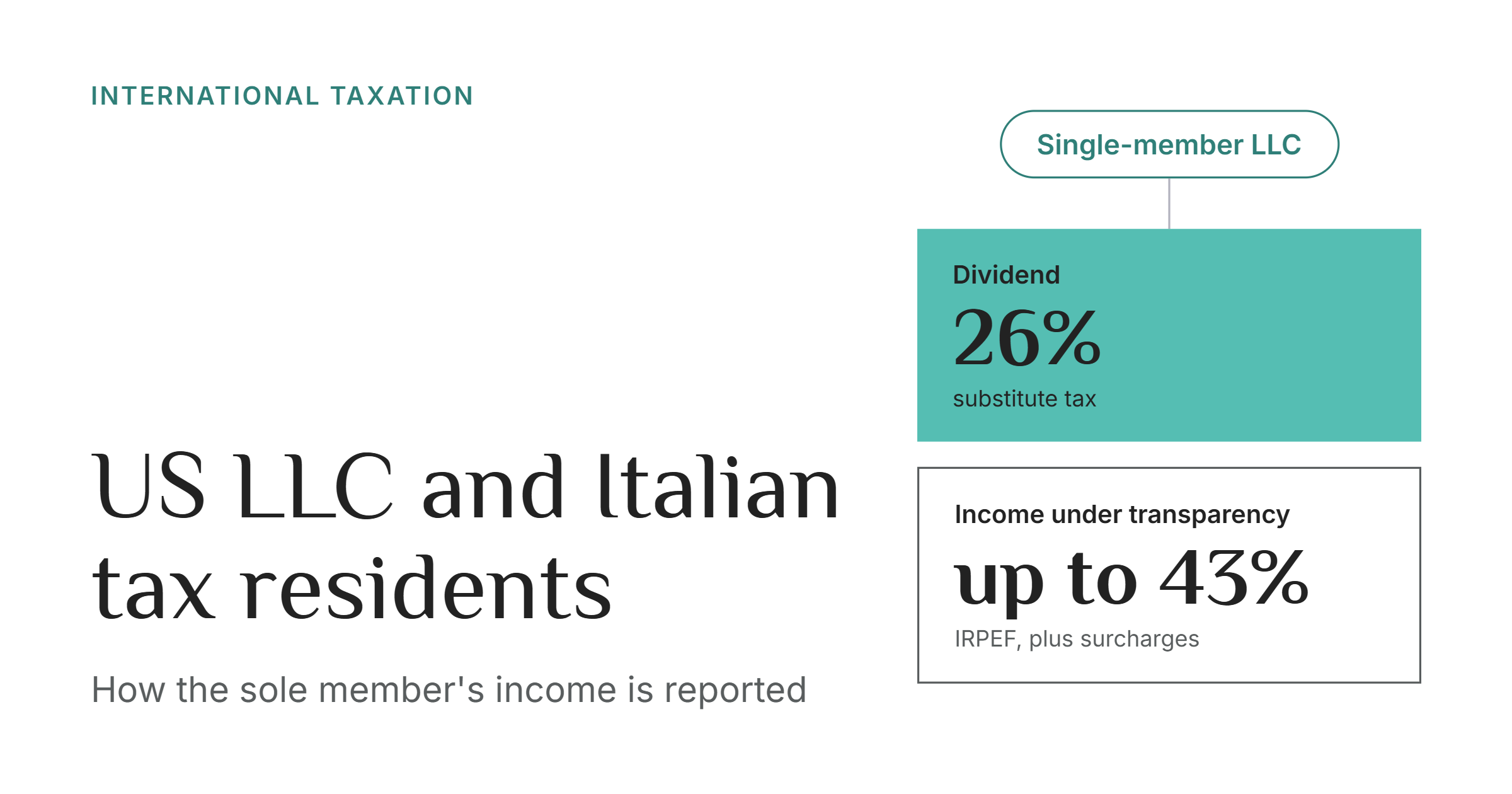
The sole member of a US LLC who is tax resident in Italy reports in Italy both the shareholding and the amounts received from the company. How those amounts are taxed depends on how the LLC is classified: as dividends, subject to a 26% substitute tax, or as income attributed to the member under tax transparency, subject to IRPEF at rates of up to 43%. The US classification is the starting point, but the characterisation for Italian purposes remains a matter for Italian law. The article starts from a case handled by the firm, anonymised.
NOW
Do you have a US LLC and are you resident in Italy?
Studio Bonaccorsi assists entrepreneurs and businesses in reviewing the entity’s classification, preparing the tax return and regularising past years.
How a single-member LLC is classified
In the United States a single-member LLC is, by default, a disregarded entity: for federal income tax purposes it is ignored as a separate taxpayer (Treas. Reg. § 301.7701-3). It can elect to be taxed as a corporation by filing Form 8832 (entity classification election, the so-called check-the-box).
Three points recur in practice:
- Operating Agreement. Partnership-style clauses (Internal Revenue Code sections 704(b) and 752, partnership minimum gain) often appear in standard templates. With a single member they have no effect on classification: a partnership requires at least two members.
- Form 8832 deadlines. The election takes effect from the date indicated, which cannot be more than 75 days before the filing date. For late elections, Rev. Proc. 2009-41 allows the form to be filed within three years and 75 days of the requested effective date, if the entity failed to obtain the intended classification solely because Form 8832 was filed late and has filed its federal returns consistently with the intended classification. It is not a general procedure that allows the most convenient regime to be chosen after the fact.
- Italian classification. Italian law does not regulate the LLC and does not automatically follow the check-the-box. Scholars and practice are not uniform: some treat the single-member LLC as a transparent entity, others as an opaque entity whose profits are dividends when distributed. The US election is the most relevant factual element, but not the only one.
Two scenarios, two tax treatments
The practical difference lies in when, and at what rate, the income is taxed in Italy. The pairing of the US election with the Italian characterisation in the table is indicative: the characterisation in Italy must be verified against the legal and operational features of the entity and the applicable Italian rules. Form 8832 is a relevant element, not a guarantee of outcome.
| Possible tax transparency | Possible tax opacity (corporation election) | |
|---|---|---|
| Starting point | No election: disregarded entity | Form 8832 effective from the relevant period |
| Characterisation in Italy | LLC income attributed to the member, as business or self-employment income depending on the activity | Dividend (art. 44 TUIR) |
| When taxed | Every year, even without distributions | On a cash basis, when received |
| Italian tax | Progressive IRPEF, up to 43% plus surcharges; social security contributions where due | 26% substitute tax (art. 18 TUIR and art. 27 DPR 600/1973), with the taxable base to be verified (gross amount or net of foreign withholding) |
| US tax | Depends on the activity: reporting obligations (Form 5472 with a pro forma Form 1120) and tax only on income connected with a US trade or business | 21% federal tax at company level, plus any state tax; 15% treaty withholding on dividends (art. 10 Italy-US Convention) |
| Foreign tax credit | To be verified, depending on the nature of the foreign tax, its finality and its correspondence with the income taxable in Italy (art. 165 TUIR) | No: the substitute tax does not allow a credit for the withholding |
The corporation election does not reduce the burden by itself. On 100 of profit before tax, distributed in full to the member:
- federal tax at company level: 21, leaving 79;
- US withholding at 15% on the dividend: 11.85, leaving 67.15;
- Italian 26% substitute tax: 17.46 if the base is the amount net of withholding (67.15), 20.54 if it is the gross dividend (79).
The total burden is about 50.3 or about 53.4, depending on the Italian taxable base, with no credit for the foreign withholding and before any state tax. The base must be verified against art. 18 TUIR and the tax documentation of the payment; the example also assumes that the transfers are dividends taxable in Italy and that the treaty withholding applies. In the transparent scenario the marginal IRPEF rate is 43% plus surcharges, in addition to social security contributions where due. The corporation election is mainly advantageous when most of the profit stays in the company and is not distributed to the member.
A practical case
A client resident in Italy set up an LLC in the United States, of which he is the sole member with a 100% interest. In its first full year of activity the LLC sent twelve international wire transfers with an identical payment reference to his Italian bank account, for about USD 120,000, equal to about EUR 110,000 converted at the exchange rate of the day of each receipt (art. 9, paragraph 2, TUIR).
Three elements shaped the approach:
- Classification. No corporation election was on file: the LLC was a disregarded entity. The Operating Agreement contained partnership-style clauses which, with a single member, had no effect.
- Characterisation of the wires. The US adviser had stated that no distributions had been paid. The wires therefore had to be reconciled with the LLC’s accounts: dividends, compensation, loans or drawings produce different effects.
- Information already given to the client. The client had been told that the transfers would be taxed as dividends at 26%, before the Operating Agreement had been reviewed. That indication holds only if the LLC is opaque.
The objective agreed with the client is to bring the flows within dividends, taxed only with the 26% substitute tax, and not within income attributed under transparency at marginal rates of up to 43%. On EUR 110,000 the substitute tax would be about EUR 28,600; in the transparent scenario the portion above EUR 50,000 would be taxed at 43%, in addition to surcharges and social security contributions.
The path followed
- Review of the US documents: Operating Agreement, Form 8832, Forms 1120 and 5472 filed, and the classification adopted in each period.
- Form 8832 with retroactive effect: request to the US adviser to file the election effective from the formation date or, failing that, from the start of the first full year, relying if necessary on Rev. Proc. 2009-41.
- Reclassification of the wires: recording them as dividend distributions in the LLC’s books and in Form 1120.
- US documentation of the dividends: obtaining Form W-8BEN from the member to apply the 15% treaty withholding (art. 10 Italy-US Convention) and issuing Form 1042-S.
- Italian tax return: section RM for foreign-source dividends with the 26% substitute tax; section RW for the shareholding.
- Risk controls: review of the LLC’s economic substance (foreign-incorporated company with Italian residence risk) and the CFC test.
The outcome
If the path is completed, the wires are taxed as dividends at 26%, without attribution under transparency. The result depends on three conditions to be verified: US relief must be available, meaning that the federal returns already filed must be consistent with the intended classification; the transfers must be dividends under the applicable law and for Italian purposes, because the classification of the entity, the nature of the transfers and their Italian tax characterisation are connected but distinct planes; and the LLC must not be Italian tax resident.
If the first condition is not met, the Italian reporting remains that of the possible-transparency scenario. For this reason, checking what was filed in the United States comes before any choice in the tax return.
What is reported in Italy
Section RW. The shareholding in the LLC is a foreign financial asset to be monitored every year, even if there are no distributions (DL 167/1990). It is reported as a shareholding in a non-resident company, with the percentage held and the value determined under the criterion set by the form instructions; in the case examined, nominal value. If the LLC is transparent or holds bank accounts abroad, the beneficial owner rules must also be considered, with reference to circular 34/E of 2022.
Failure to report is penalised at 3% to 15% of the undeclared value (art. 5 DL 167/1990), doubled for privileged-tax jurisdictions. For past years, voluntary correction (ravvedimento operoso) is available. Monitoring and IVAFE (the wealth tax on foreign financial assets) are separate obligations: whether the wealth tax applies to the shareholding, and to any accounts or investments held through the LLC, must be assessed separately, taking into account the nature of the entity and the member’s position as beneficial owner.
Section RM. In the opaque scenario, foreign-source dividends received without an intermediary are reported in the section for foreign-source investment income (line RM31, with the code for dividends and the foreign country code), with the 26% substitute tax paid under tax code 1242.
Income sections. In the transparent scenario the LLC’s profit is reported in the section matching the nature of the income (business or self-employment), with any credit for taxes paid in the United States and the social security obligations that follow.
In both cases the return depends on reconstructing the movements: date and amount of each transfer, exchange rate on the day of receipt, and the characterisation recorded by the LLC.
Related risks
Foreign-incorporated company with Italian residence (esterovestizione). A company incorporated abroad is Italian tax resident if, for most of the tax period, its place of management or its main business purpose is in Italy (art. 73, paragraph 3, TUIR). Where the sole member manages the LLC from Italy, the risk must be assessed on the facts, and the corporation election does not remove it: the LLC would be subject to IRES in Italy on its worldwide income. The presumption in paragraph 5-bis concerns control structures over Italian companies and does not apply to an operating LLC. It is advisable to document US economic substance: premises, staff, and where and by whom decisions are taken.
Controlled foreign companies (CFC). If the LLC is opaque and controlled by the Italian member, art. 167 TUIR applies when the effective foreign taxation is less than half of what would apply in Italy and more than one third of the income is passive. For a company providing services to third parties with 21% federal taxation the condition is normally not met, but it must be checked every year.
US filings. For a single-member LLC with a non-resident owner, Form 5472 and a pro forma Form 1120 are due. Failure to file carries a base penalty of USD 25,000 per form. If the LLC is a corporation, an ordinary Form 1120 is added and, for dividends, Form 1042-S.
Practical checklist
- Certificate of formation and Operating Agreement: number of members, formation date, any clauses on distributions
- Form 8832 filed, with effective date and receipt; if absent, decision on the election and on relief under Rev. Proc. 2009-41
- Forms 1120 and 5472 filed for each period, and under which classification
- The LLC’s books: how transfers to the member are recorded (dividends, compensation, loans, drawings)
- List of wires with date, amount in foreign currency and exchange rate on the day of receipt
- Form W-8BEN signed by the member and Form 1042-S if there are dividends
- Italian tax residence of the member for the whole tax period
- Where decisions are taken and the LLC’s economic substance
- Section RW for previous years, with voluntary correction if omitted
Sources
- Treas. Reg. § 301.7701-3 (entity classification) and Form 8832
- Rev. Proc. 2009-41, late entity classification election (IRS text)
- Arts. 9, 18, 44, 73, 165 and 167 TUIR (Italian Income Tax Code); art. 27 DPR 600/1973
- Italy-US Convention of 25 August 1999, art. 10 (dividends)
- DL 167/1990, arts. 4 and 5 (tax monitoring and penalties); Italian Revenue Agency circular 34/E of 2022
- IRC § 6038A (Form 5472)
Disclaimer. The content of this article is for general information only and is not professional advice or tax or legal consultancy. The case described is anonymised and simplified; conclusions depend on the facts and documents of each situation and on the law in force at the date of publication. Studio Bonaccorsi accepts no liability for decisions taken on the basis of what is stated here.